 GELO BISNIS
BELOK
Best
Lokasi
Stop guessing. Start knowing. AI-powered location intelligence that tells you exactly where your FnB franchise belongs before you sign the lease.
Location is the single biggest variable in whether an FnB business survives its first year yet most owners still choose it based on gut feel.
You've seen it happen: a café opens with a perfect menu and beautiful interiors, only to close six months later. Not because of the food, not because of the staff but because of the location. Was there enough foot traffic? Were there too many competitors nearby? Was parking accessible? Was the pricing aligned with the surrounding area?
These are the questions GELO BISNIS BELOK (Best Lokasi) was built to answer, instantly.
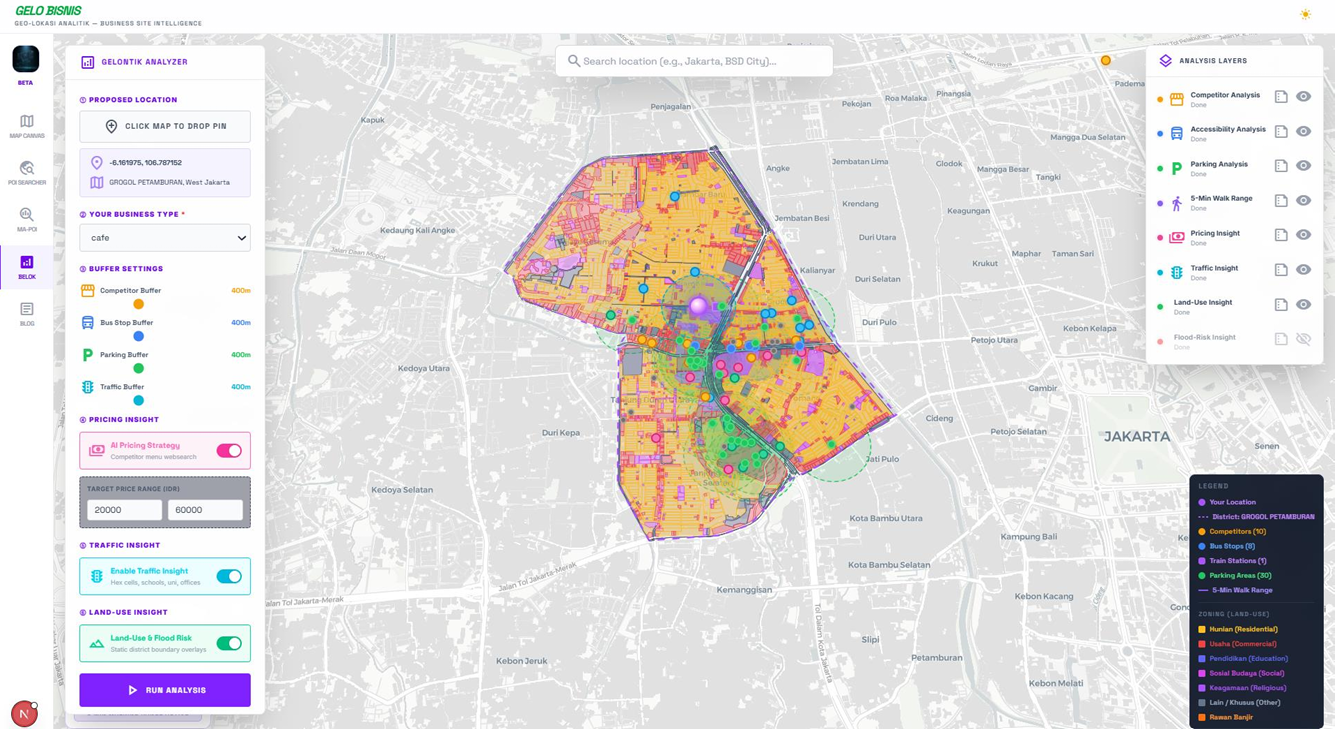
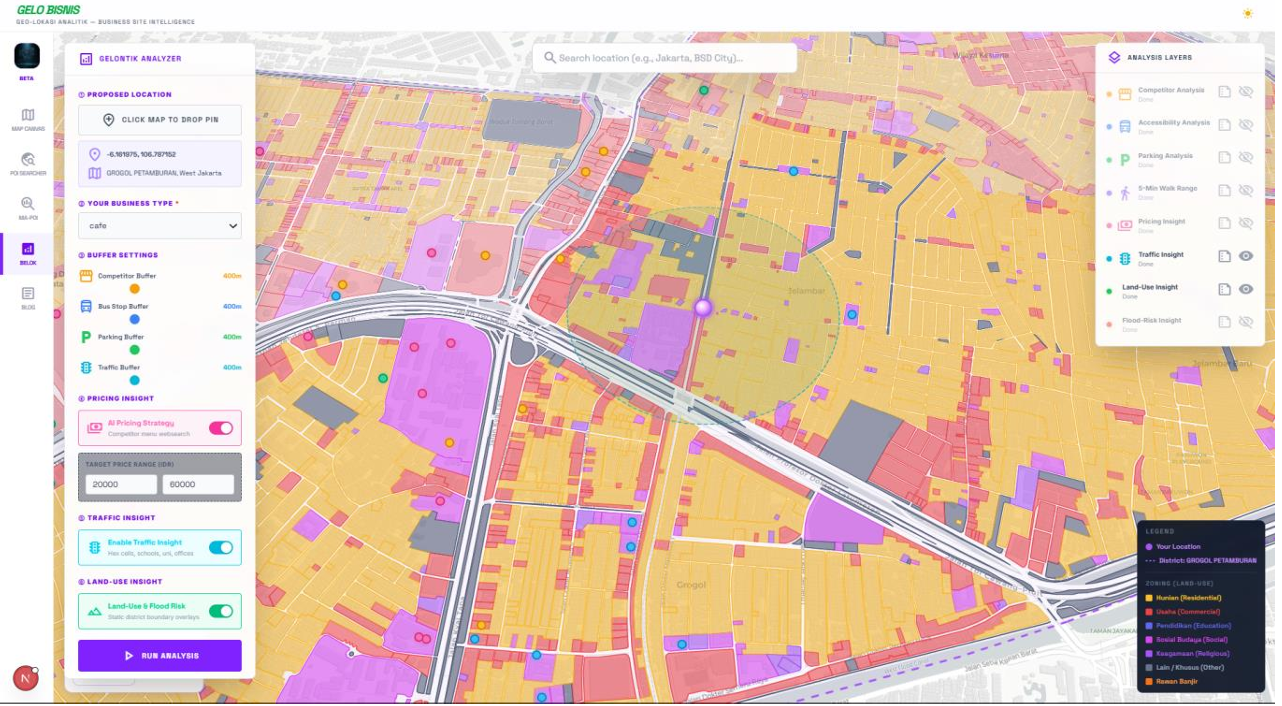
What you're looking at in the dashboard above is the full power of BELOK in action: a single interface that layers competitor data, transport accessibility, parking zones, traffic sources, land-use classifications, and AI-generated pricing intelligence all mapped against your proposed location in real time.
From pin drop to full report in minutes.
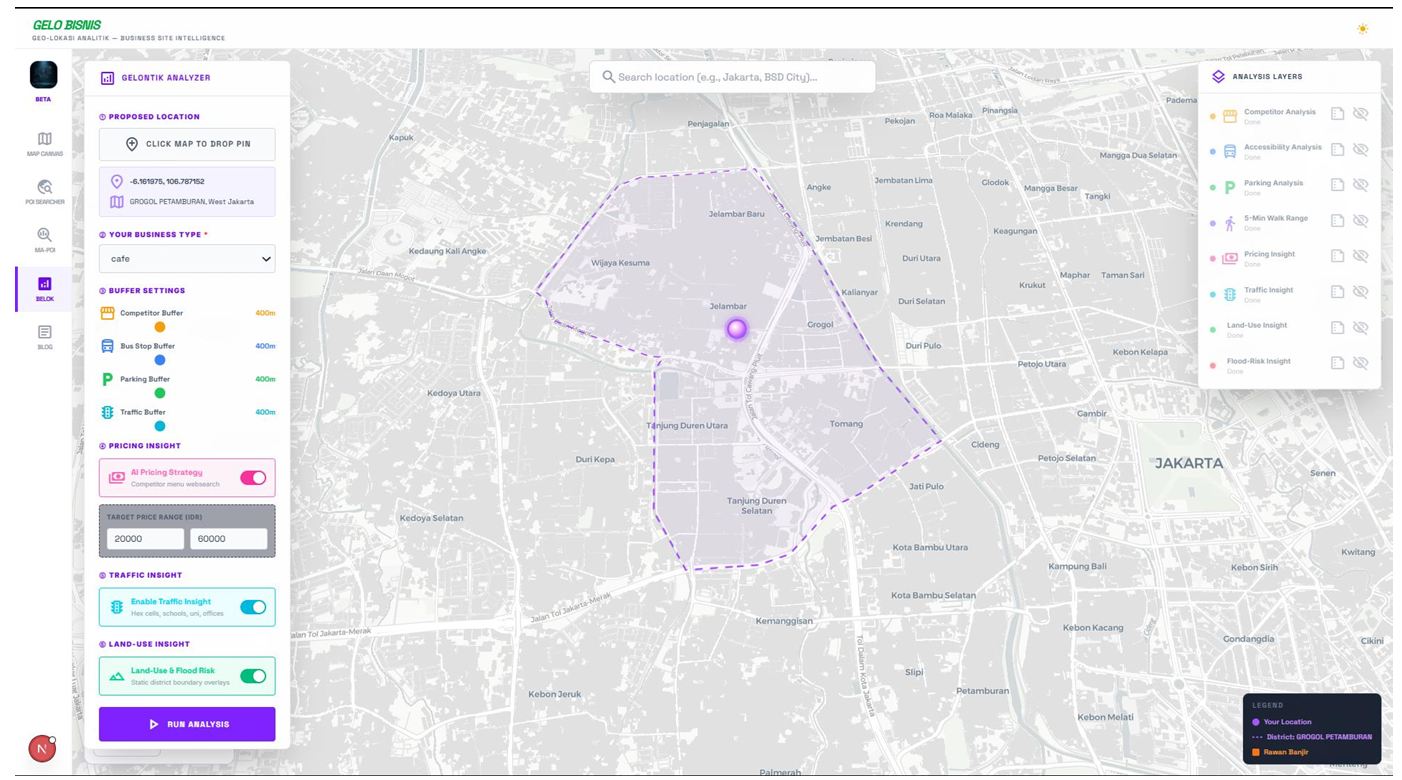
The workflow is deceptively simple. Pick a location anywhere across Jakarta or BSD City either by clicking directly on the map or using the built-in map search and the platform instantly renders a kecamatan-level boundary around your area of interest.
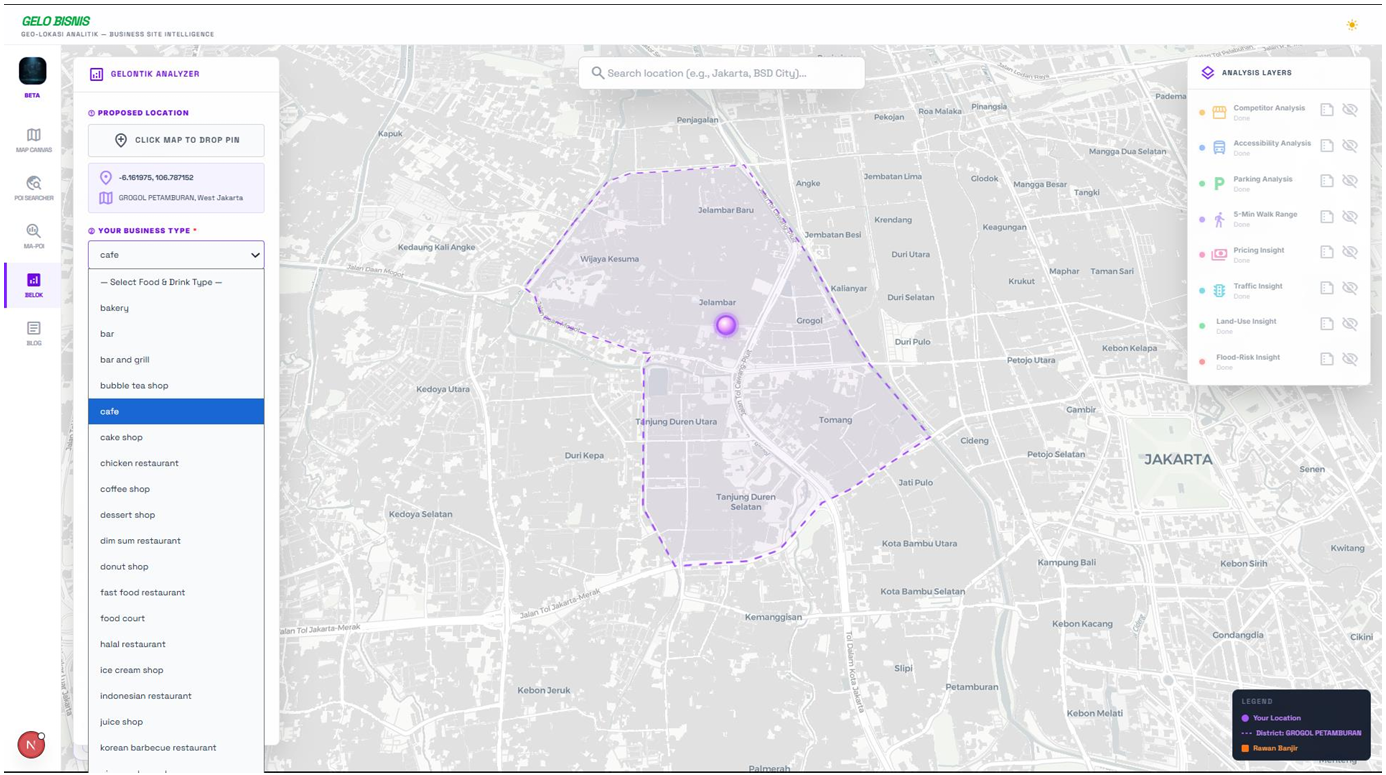
From there, you define your business type choosing from an extensive list that includes cafés, coffee shops, bubble tea shops, bakeries, fast food, Korean BBQ, dessert shops, Indonesian restaurants, juice bars, and more. The platform then configures its analysis buffers accordingly, defaulting to 400m for competitor, bus stop, parking, and traffic layers.
Once your location and business type are set, you toggle on whichever insight modules are relevant to your decision. For the walkthrough below, all three advanced modules Pricing, Traffic, and Land-use are activated simultaneously before hitting Run Analysis.
Every angle of your location, decoded.
BELOK runs seven distinct intelligence modules simultaneously each one answers a question a business owner must resolve before committing to a site.
Analysis
Insight
Competitor Analysis Spatial Intelligence
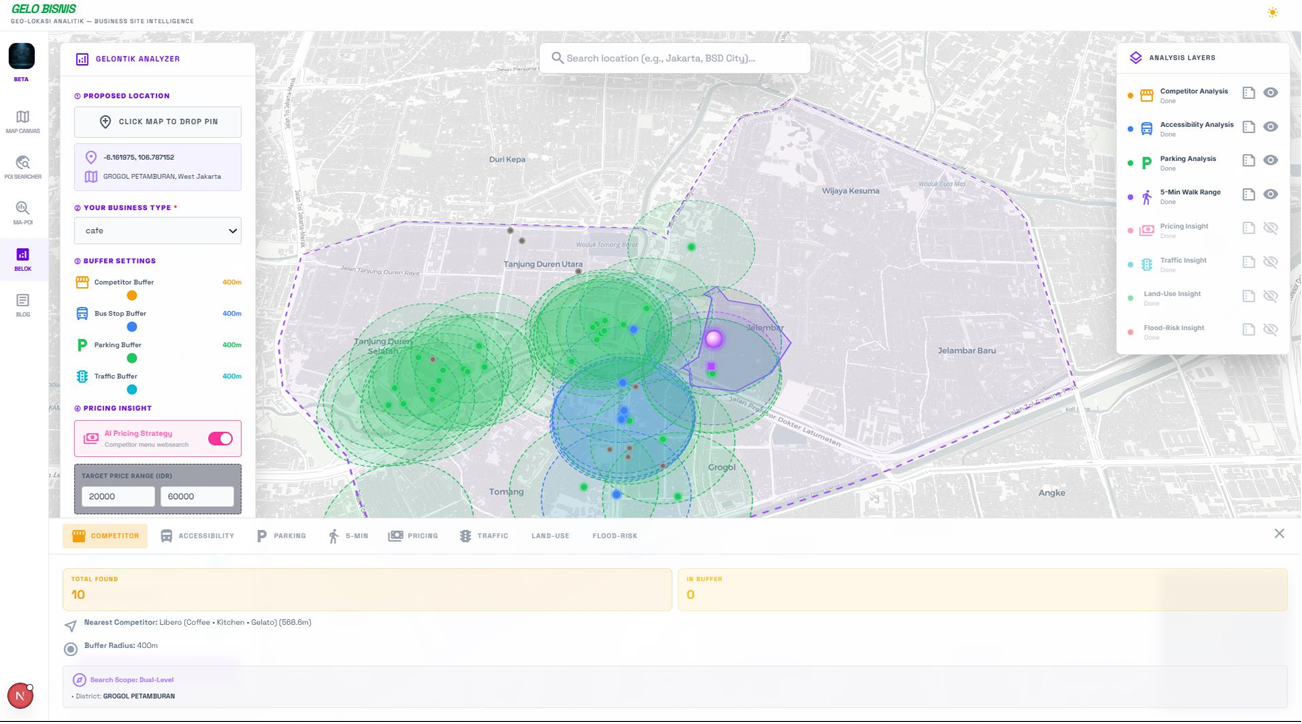
The chosen location is marked by the purple circle on the map. Running the competitor analysis for a café in Grogol, the first finding is striking: no direct competitor exists within the 400m buffer. That's a clean, uncontested immediate zone.
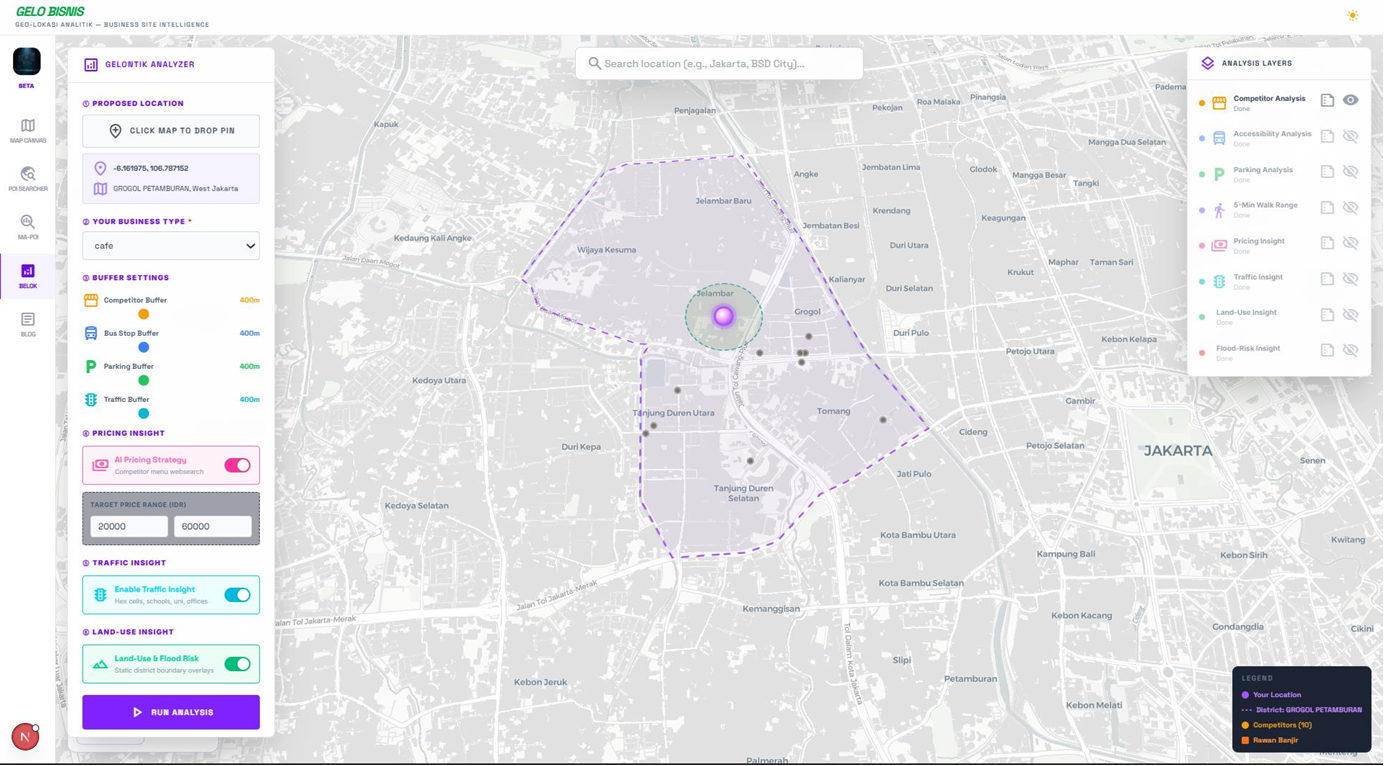
Zooming out, grey competitor icons reveal multiple cafés operating within the broader 3–5 km radius. This is actually a positive signal: the presence of food & beverage clusters in the surrounding area confirms market demand exists in the district. The selected spot benefits from that validated demand without facing the direct headwind of an immediate competitor.
Accessibility Insight Transport POIs
Accessibility analysis extracts all nearby public transportation POIs and places a 400m catchment buffer around each one. The map reveals that the proposed location falls comfortably within the service range of Grogol Station, significantly boosting its potential commuter traffic.
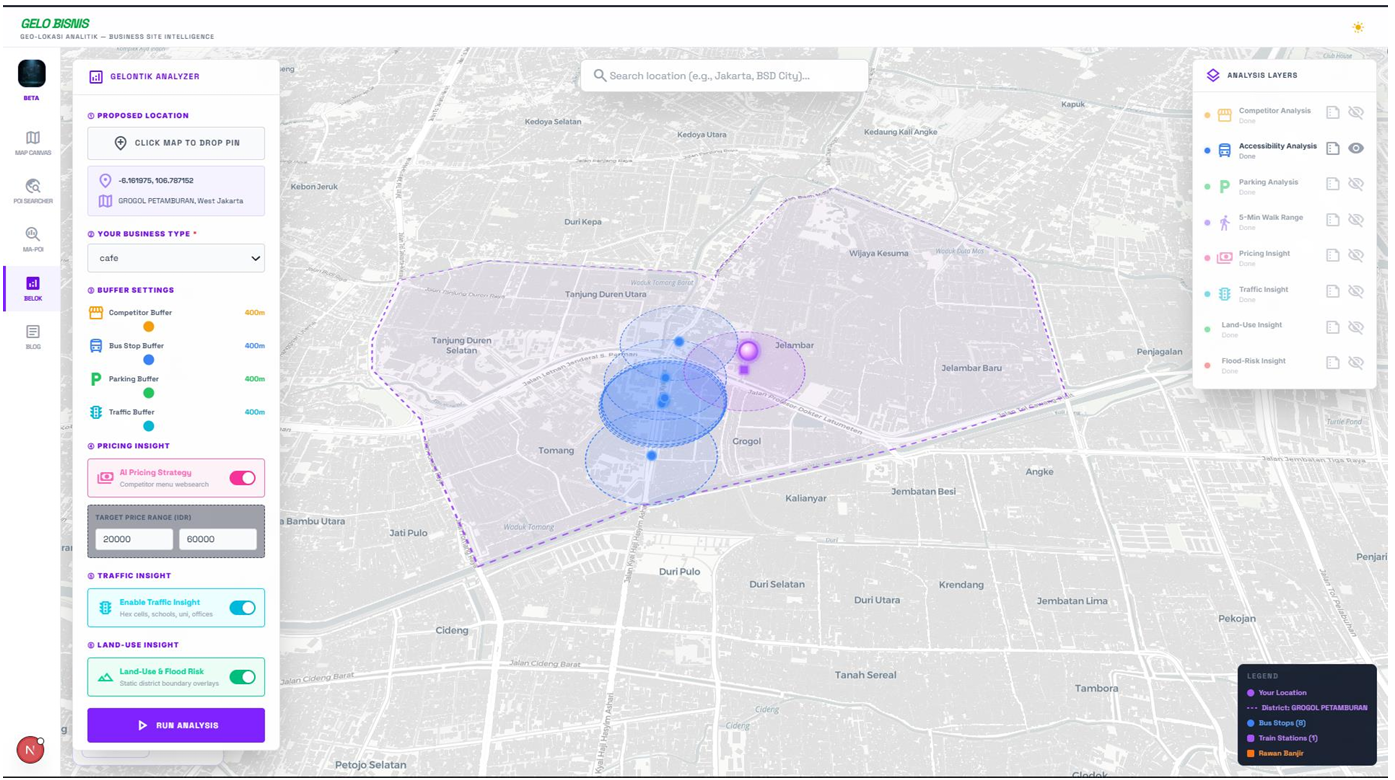
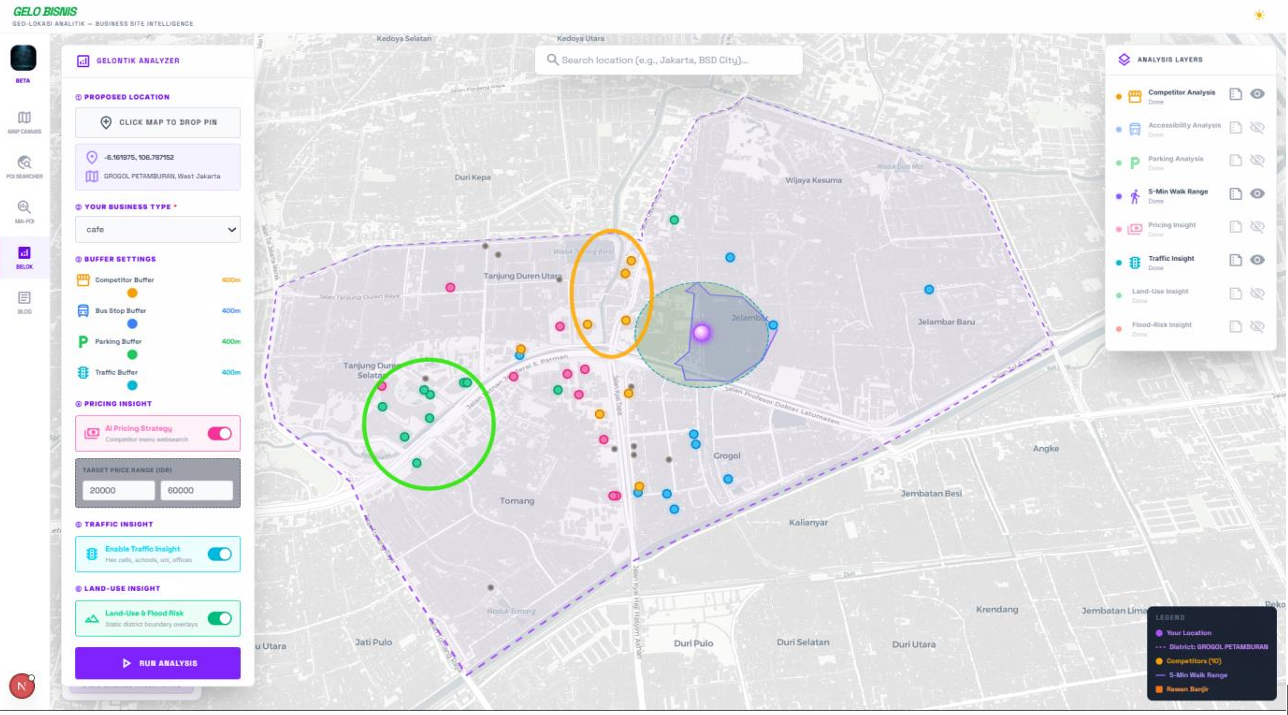
Overlaying competitor POIs with transport POIs reveals a key nuance: a competitor cluster concentrates precisely within the highest-accessibility zone (highlighted in red). This tells us that while competition is stiffer closest to the station, our site sits just far enough outside to avoid direct competition while still benefiting from commuter flow.
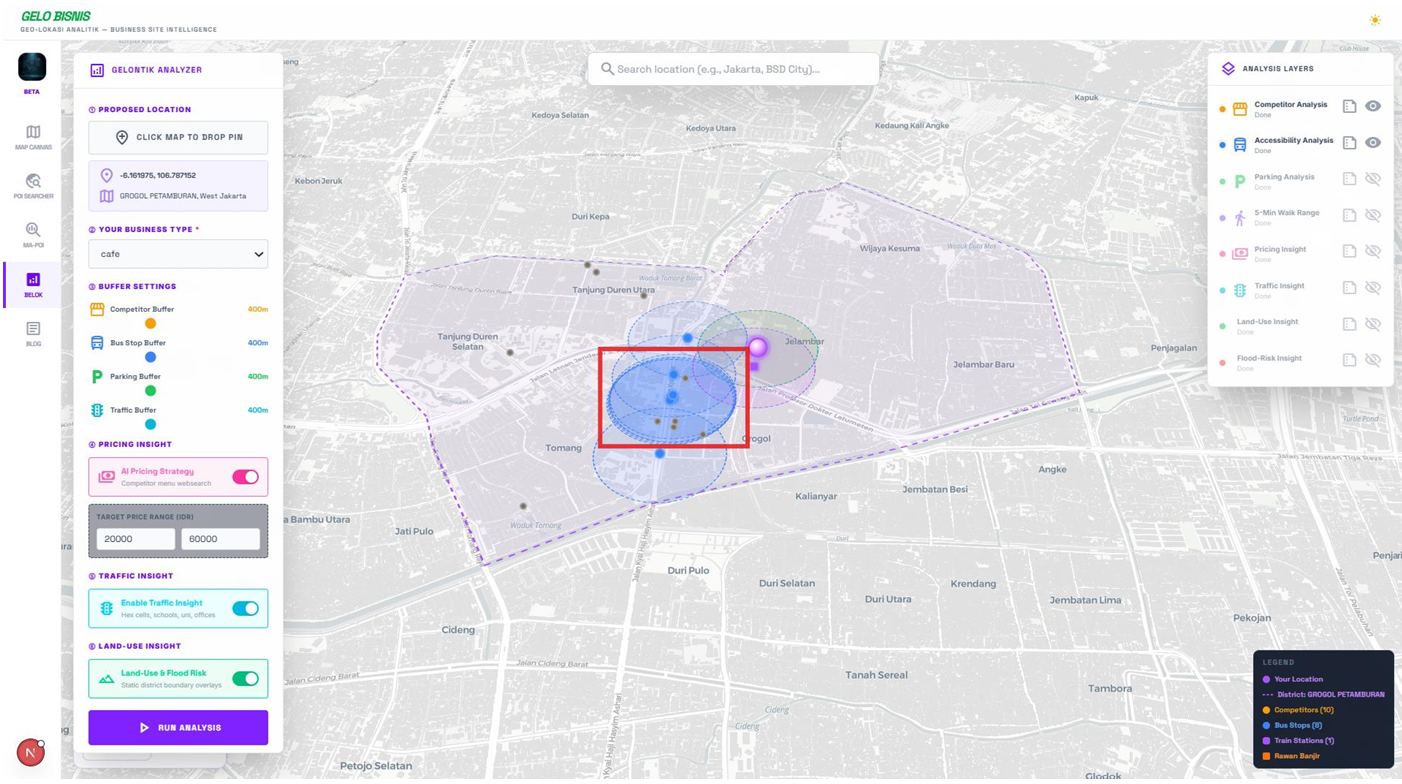
Activating the 5-minute walk range confirms the site sits within a natural pedestrian corridor between Grogol Station and the bus stop a sub-1 km stretch that everyday commuters traverse on foot. This is a consistent, repeatable source of organic foot traffic.
Parking Insight Vehicle Access
Indonesia's FnB customer base is predominantly motorcycle and car-dependent. Parking accessibility is not a nice-to-have it is a core traffic driver. The parking module extracts supermarkets, shopping malls, and dedicated parking facilities within the buffer and maps their coverage zones.
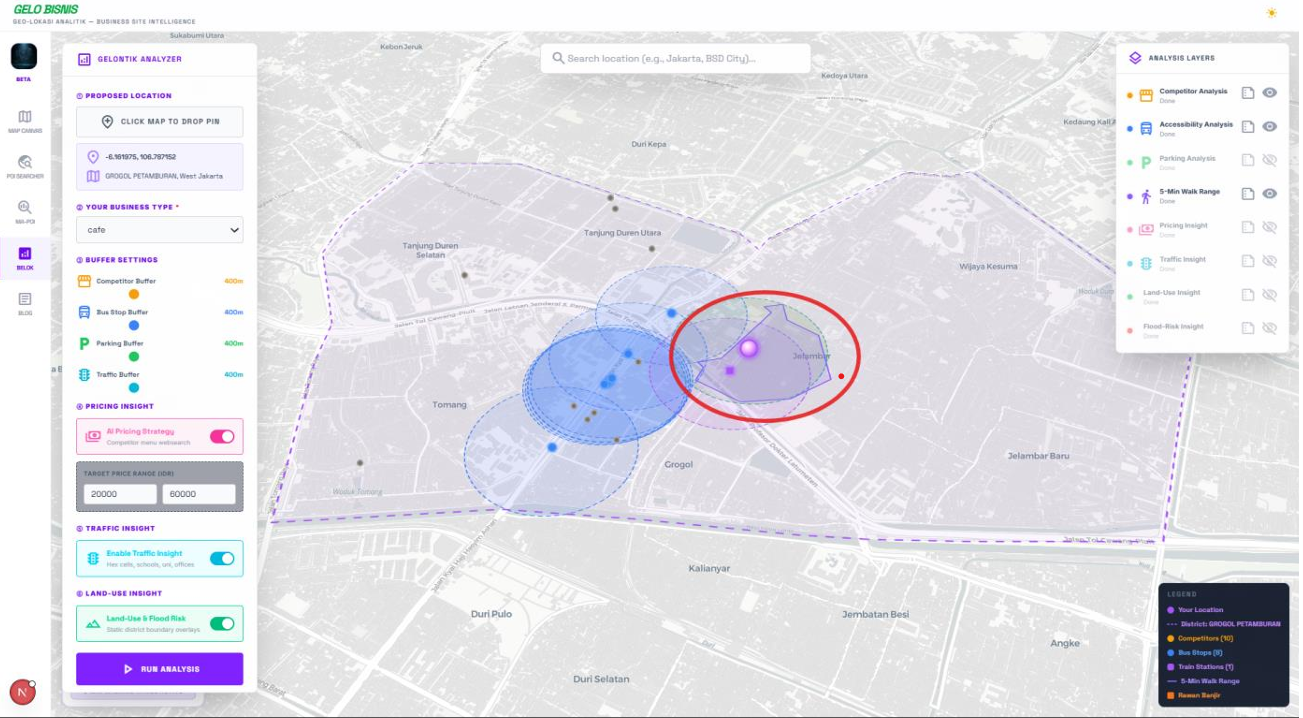
Combined Layer View Full Picture
Activating Competitor, Accessibility, and Parking layers simultaneously produces the definitive site verdict. The bottom panel confirms the nearest competitor Libero Café sits over 500m away, safely beyond the direct competition threshold. Both parking and transport access are confirmed as covered.
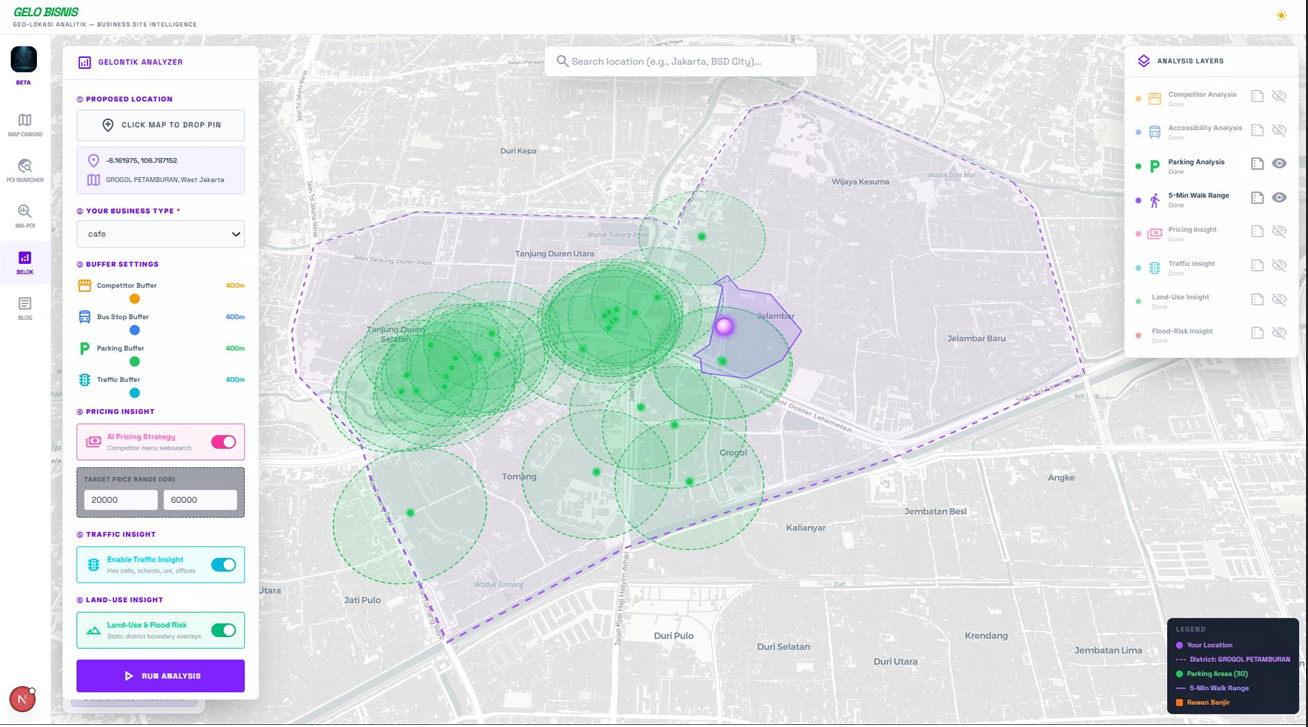
The combination verdict: the chosen location in Grogol sits in a competitive blind spot far enough from direct competitors to avoid head-to-head pricing pressure, while benefiting from robust public transport links and ample parking. That's a rare trifecta in a dense urban district.
Traffic Insight Demand Generators
Location infrastructure without customer demand is meaningless. The Traffic module identifies the four key demand generators that consistently bring walk-in FnB customers: schools, universities, hotels, and office spaces. Each category is mapped as a distinct color-coded layer.
For this Grogol café location the findings are nuanced and honest. The nearest demand generator within walking distance is SMPN 83 (a junior high school, shown as blue icon). Hotels are approximately 1 km away a realistic drive, less ideal for walk-ins. Office clusters are further from the core zone.
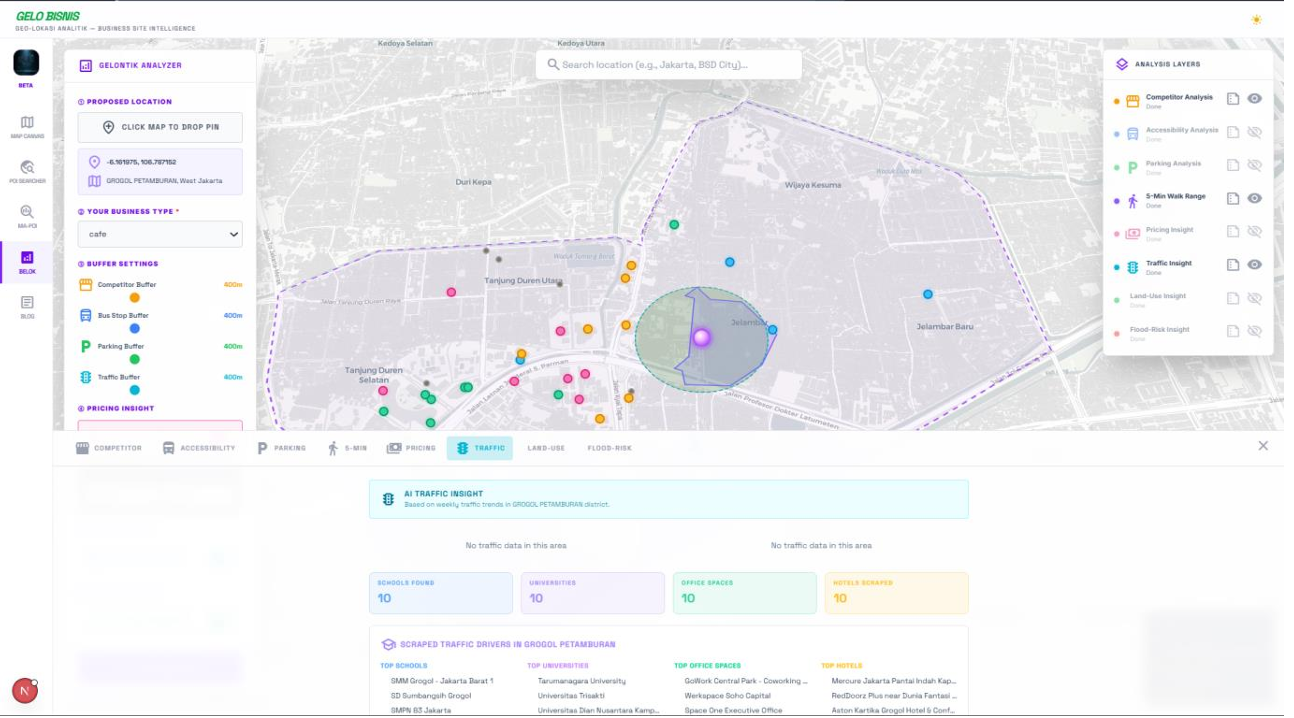
The takeaway: this location is best positioned to capture student, commuter, and hotel visitor traffic. Operators targeting the lunch-rush office crowd may want to weigh this against competing sites. BELOK gives you the honest picture not just the flattering one.
Land-Use Insight Zoning Intelligence
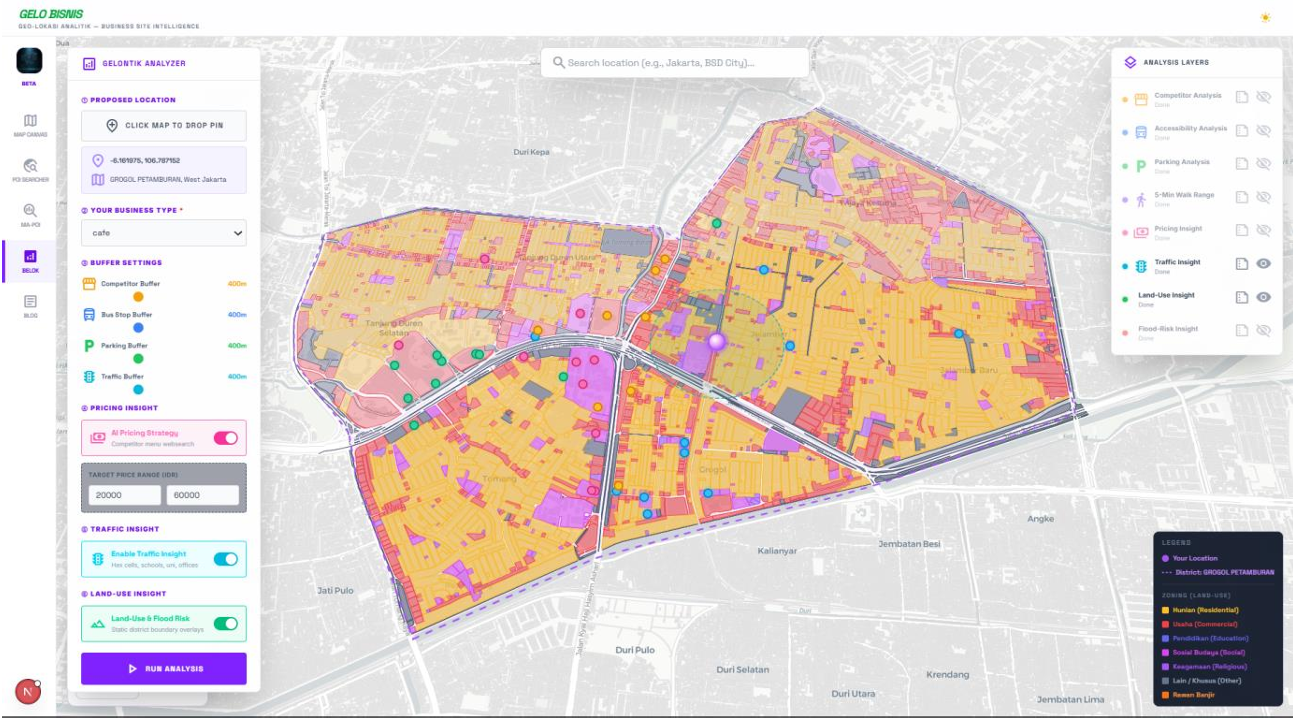
Opening a food business in a residentially zoned plot is a legal and operational landmine. The Land-Use module overlays official Jakarta zoning data to let you confirm two critical things at a glance: that the site sits in a commercial zone (legally permitted for trade), and that it borders residential areas that act as natural customer catchment.
Pricing Insight AI-Powered
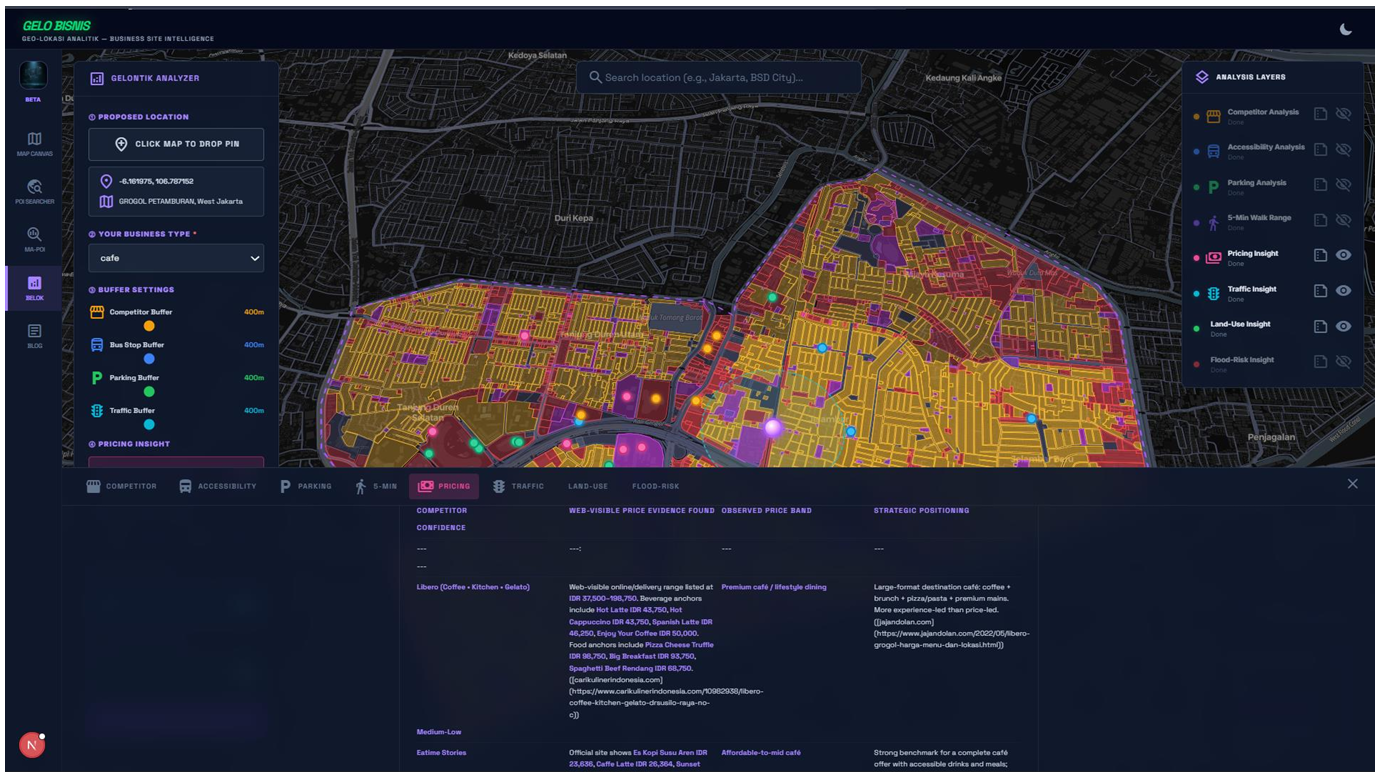
Even a perfectly located café will underperform if it's priced incorrectly for its market. Too low and margins erode. Too high and you price out the very traffic generators nearby. The Pricing module deploys Agentic AI to extract live menus from competitor cafés in the area, benchmark them against your defined price range, and generate a stratified pricing strategy.
The output is structured into three tiers: a Medium-Low confidence band (where competitor data is sparse), a Medium-Low to Medium band (sweet spot), and a Below-Median zone. Each tier is evaluated for its viability and strategic fit given the location's foot-traffic profile.
The final output is a Strategic Pricing Recommendation broken down by product category. For a café targeting the Grogol market, the AI advises building a 3-tier beverage ladder:
| Tier | Product Examples | Price Range (IDR) | Status |
|---|---|---|---|
| Entry / Traffic Drivers | House iced Americano, Black coffee, Lemon tea, Simple fruit tea | 20,000 – 28,000 | Essential |
| Core / Margin Zone | Latte, Cappuccino, Matcha Latte | 29,000 – 38,000 | Sweet Spot |
| Signature / Premium | Specialty single origin, Elevated signature drinks | 39,000 – 50,000 | Use selectively |
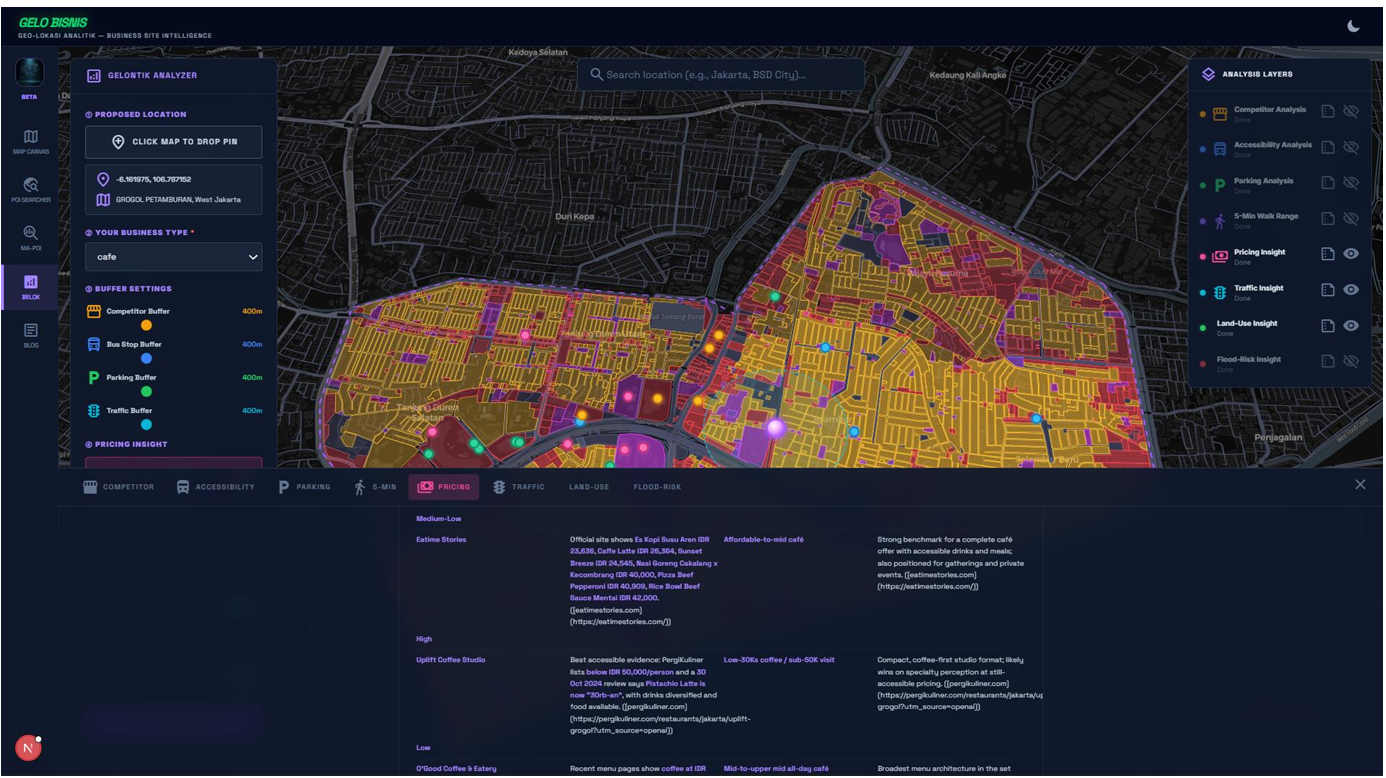
This is the complete BELOK output for a single proposed café location in Grogol. Seven modules. Competitor blind-spot confirmed. Transport access verified. Parking covered. Demand generators mapped. Zoning cleared. Pricing benchmarked and recommended. All in one sitting, in one interface.
Traditional location surveys take months and cost millions. Gut feel costs you the whole business.
Most FnB entrepreneurs in Indonesia do one of two things: they pick a location based on instinct and personal familiarity, or they commission a lengthy physical survey that consumes months of preparation and produces a report that's already outdated by the time they read it.
Neither approach is good enough in a market where a bad location decision is the single most common reason a food business fails in its first year. BELOK was built to be the middle path: systematic, fast, multi-dimensional, and affordable enough to run before committing to any site.
It doesn't replace local knowledge or business judgment. It equips it. You still make the call BELOK just makes sure you're making it with your eyes open.
Ready to find your
Best Lokasi?
Join the businesses across Jakarta and BSD City using GELO BISNIS BELOK to make smarter, faster location decisions.
Contact GELO BISNIS